Silicon
Collection of (semi-) empiric functions describing silicon properties.
-
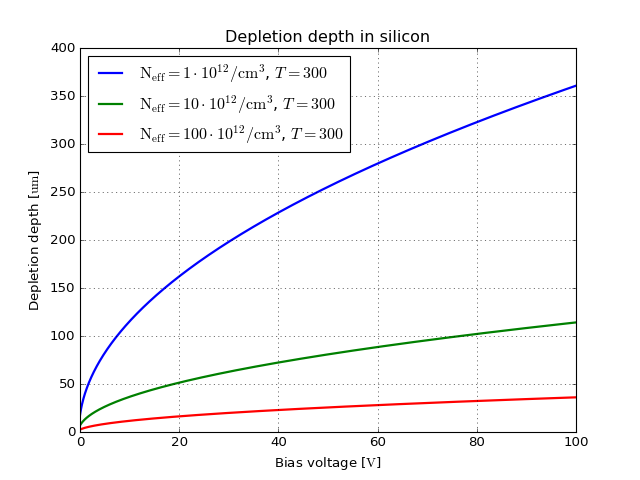
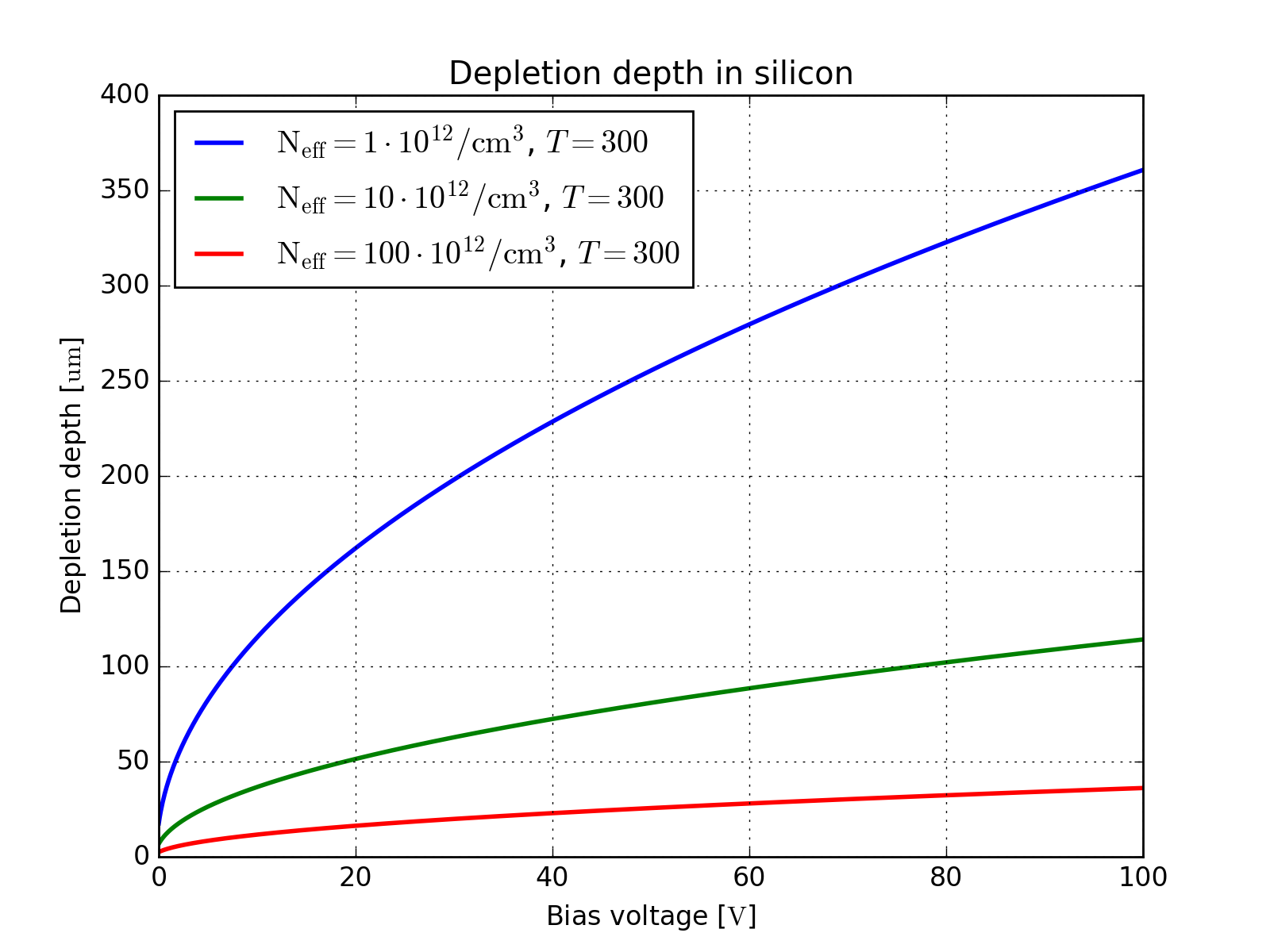
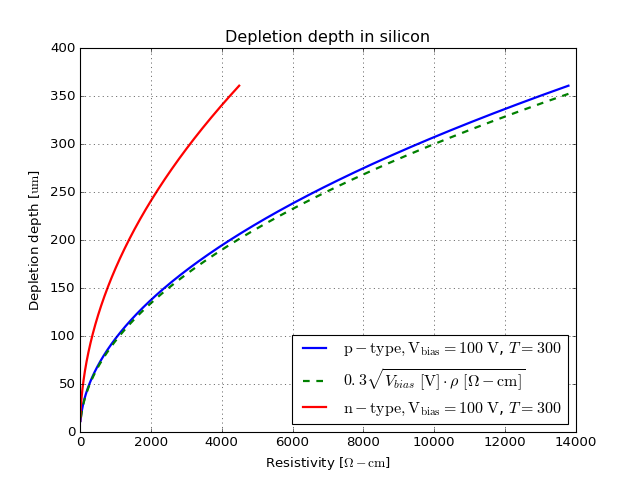
scarce.silicon.get_depletion_depth(V_bias, n_eff, temperature)[source]¶ Depletion depth [um] of silcon with an effective doping concentration n_eff [10^12 /cm^3] at a temperature [K] and reverse bias V_bias [V].
Check/citetation of formulars needed!
(Source code, png, hires.png, pdf)
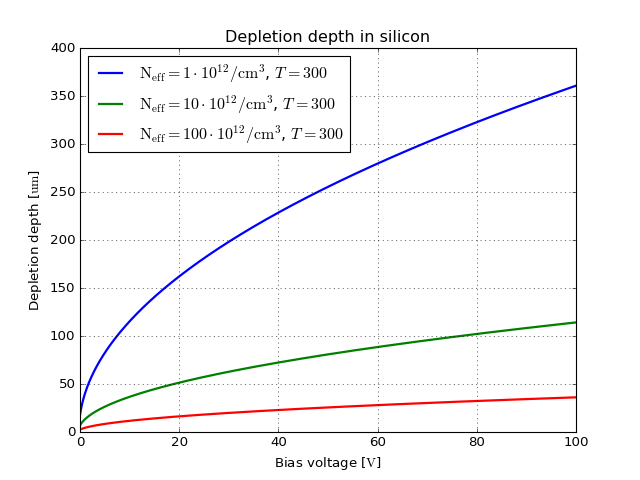
(Source code, png, hires.png, pdf)
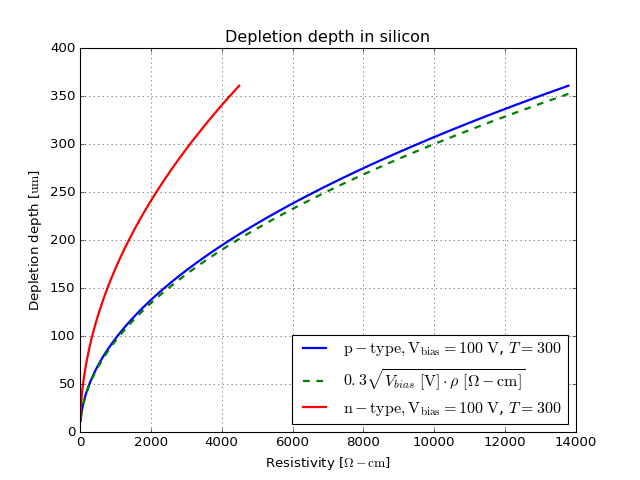
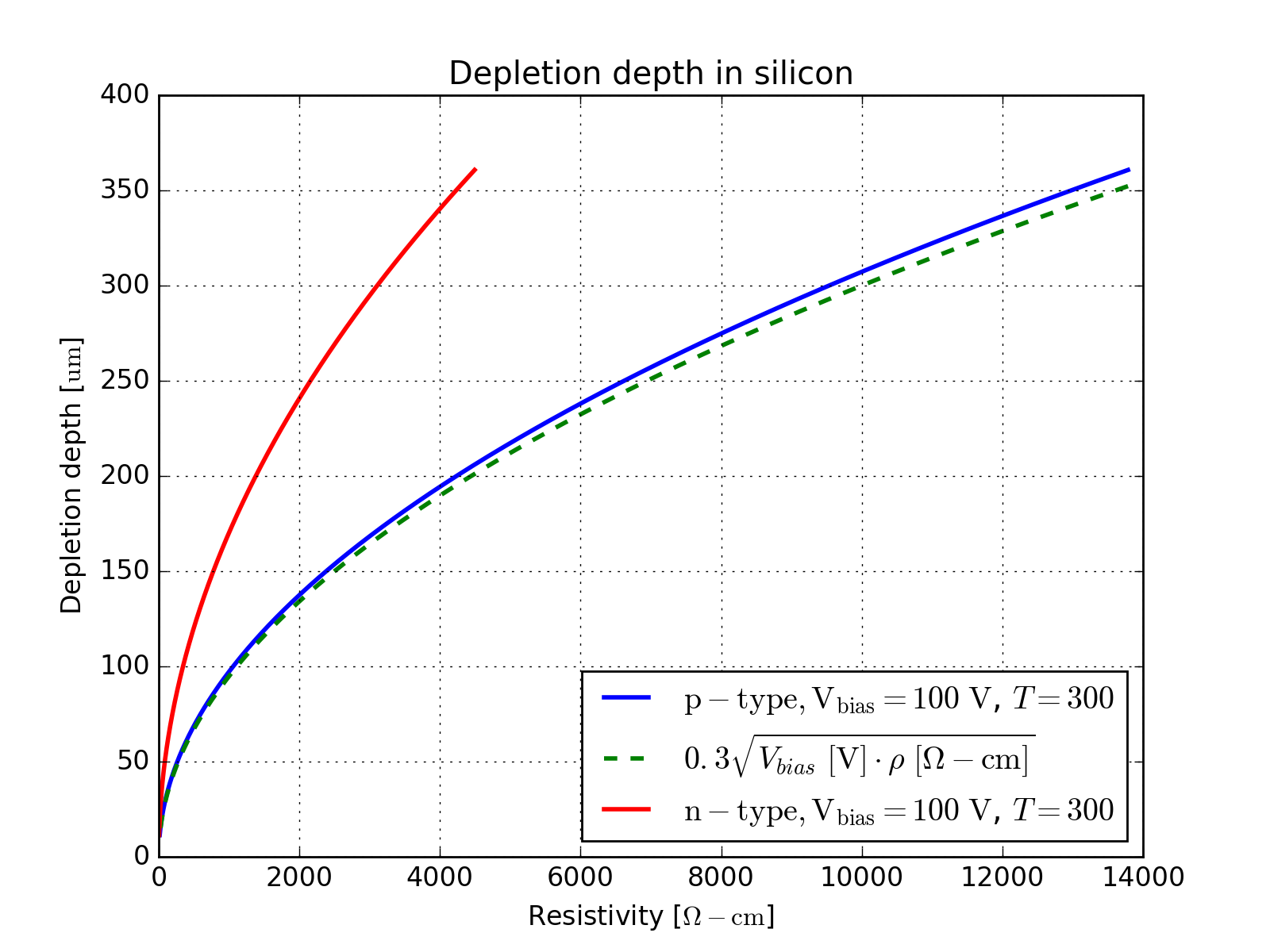
-
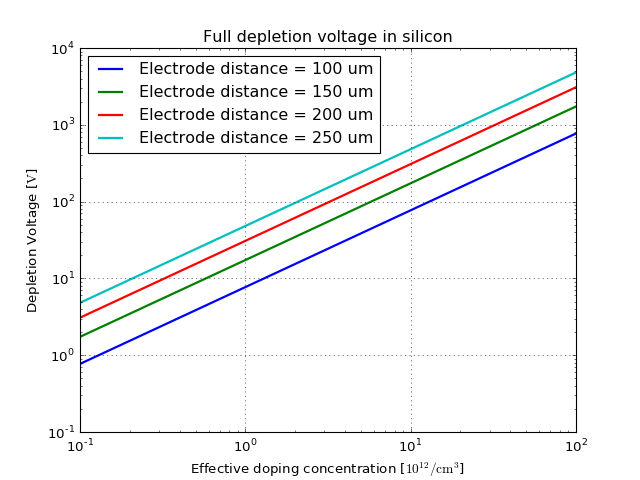
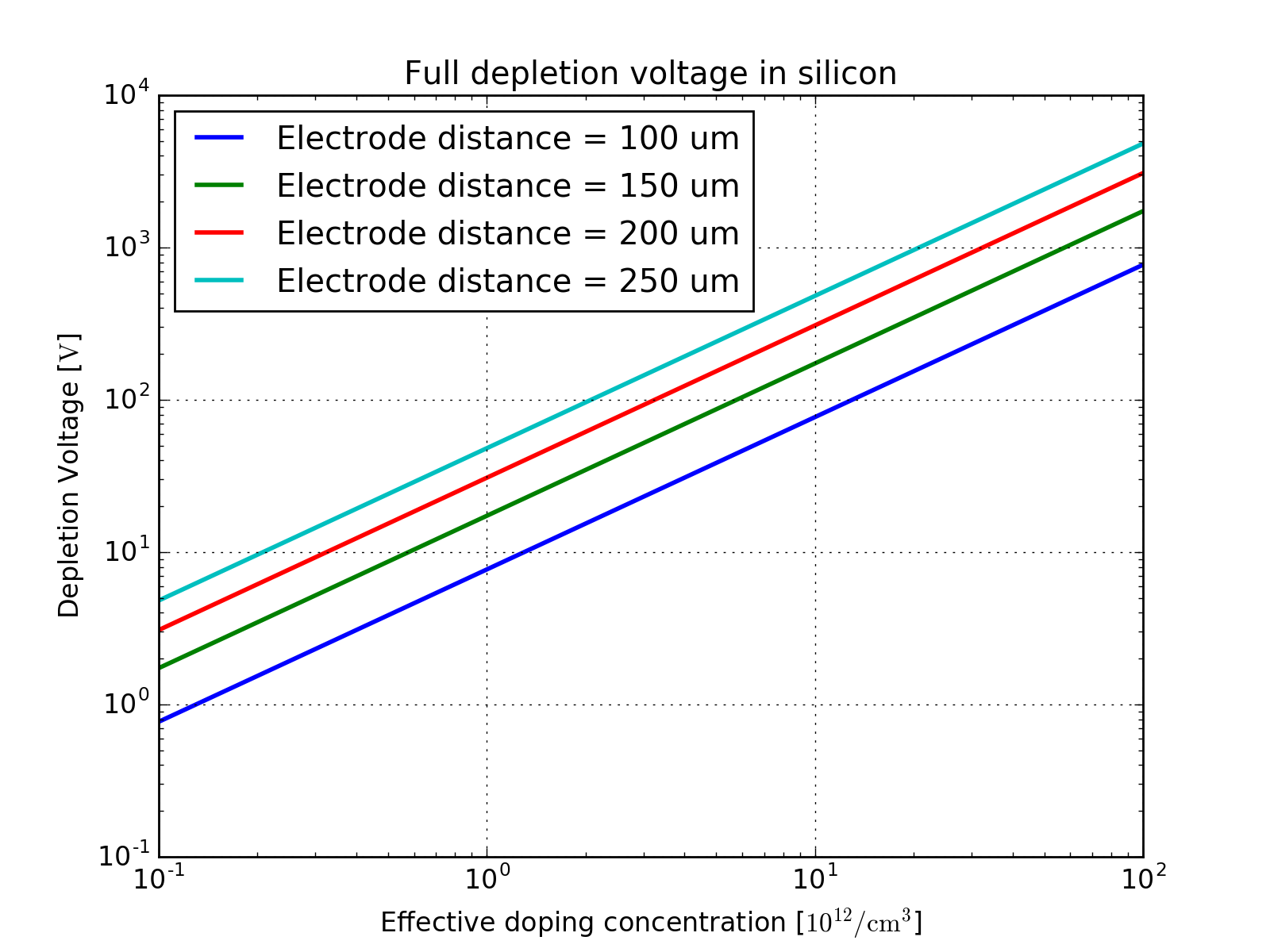
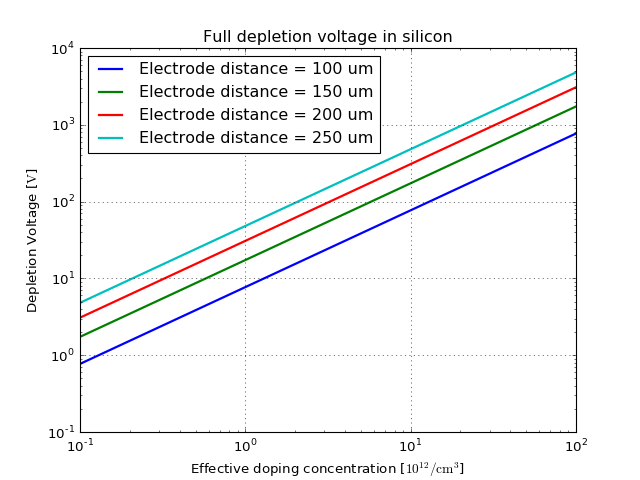
scarce.silicon.get_depletion_voltage(n_eff, distance)[source]¶ This function returns the full depletion Voltage [V] as a function of the effective doping concentration Neff [10^12 /cm^-3] and the distance between electrodes [um]. Formular is standard and for example used in: G. Kramberger et al., Nucl. Inst. And. Meth. A 476 (2002) 645-651 ‘Determination of effective trapping times for electrons and holes in irradiated silicon’.
(Source code, png, hires.png, pdf)
-
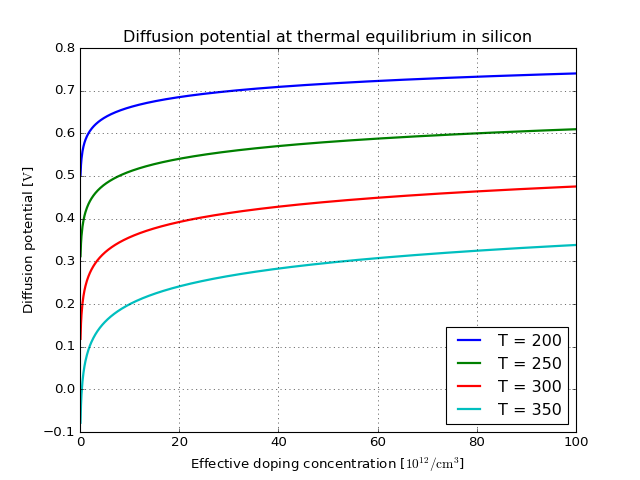
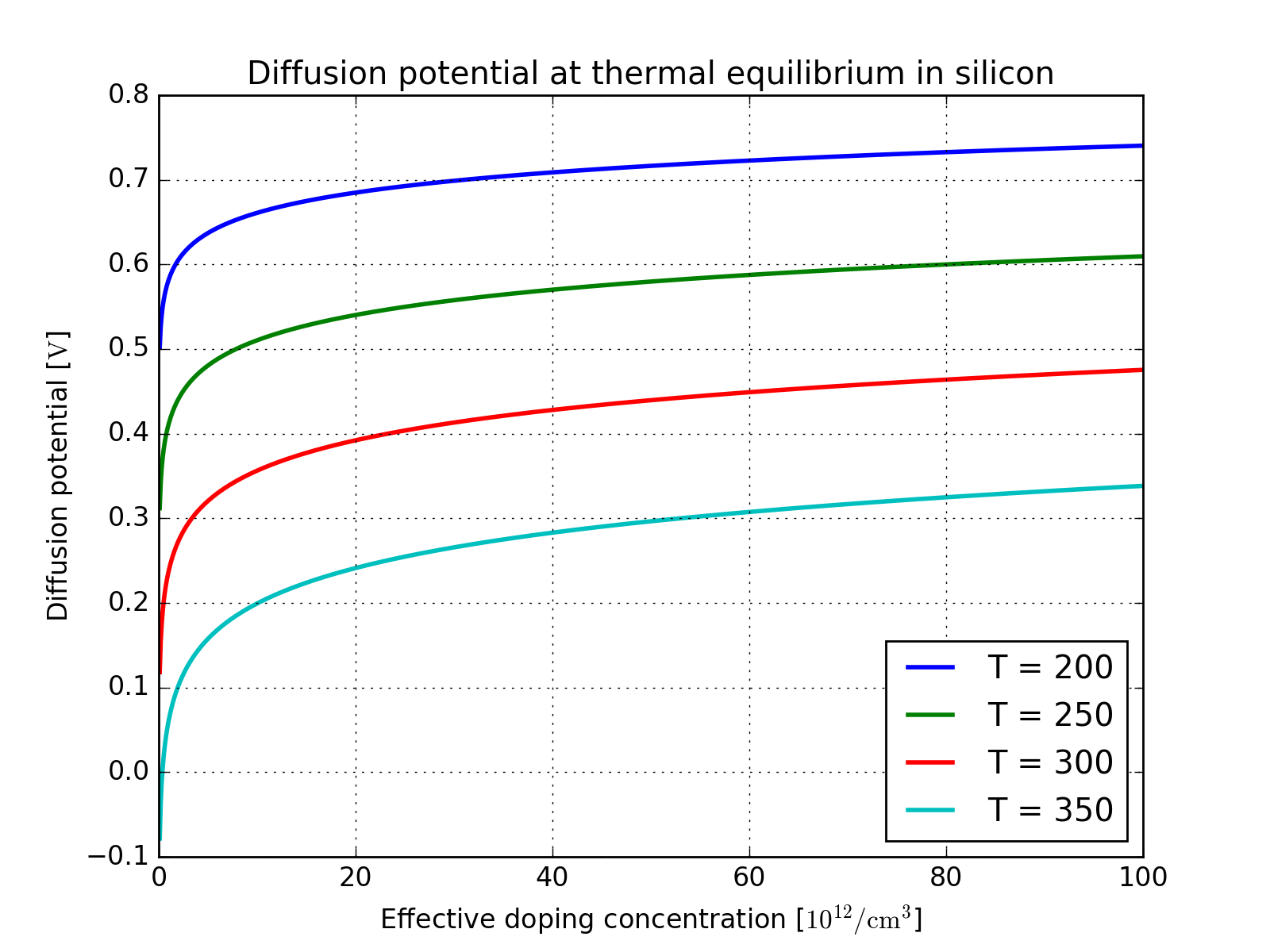
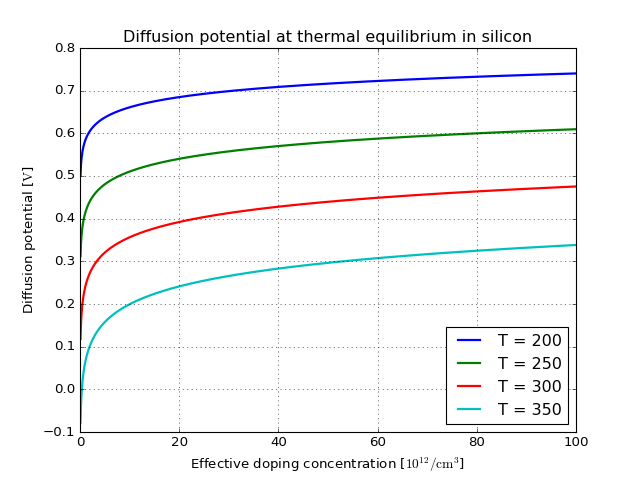
scarce.silicon.get_diffusion_potential()[source]¶ Diffusion potential [V] as a function of the effective doping concentration n_eff [10^12 / cm^3] and the temperature [K].
Check/citetation of formulars needed!
(Source code, png, hires.png, pdf)
-
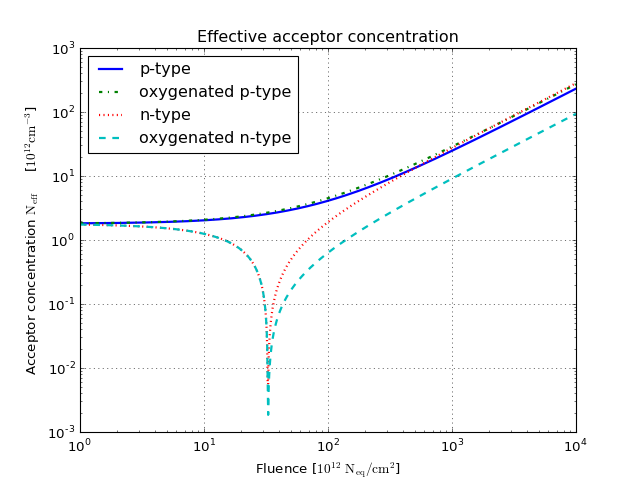
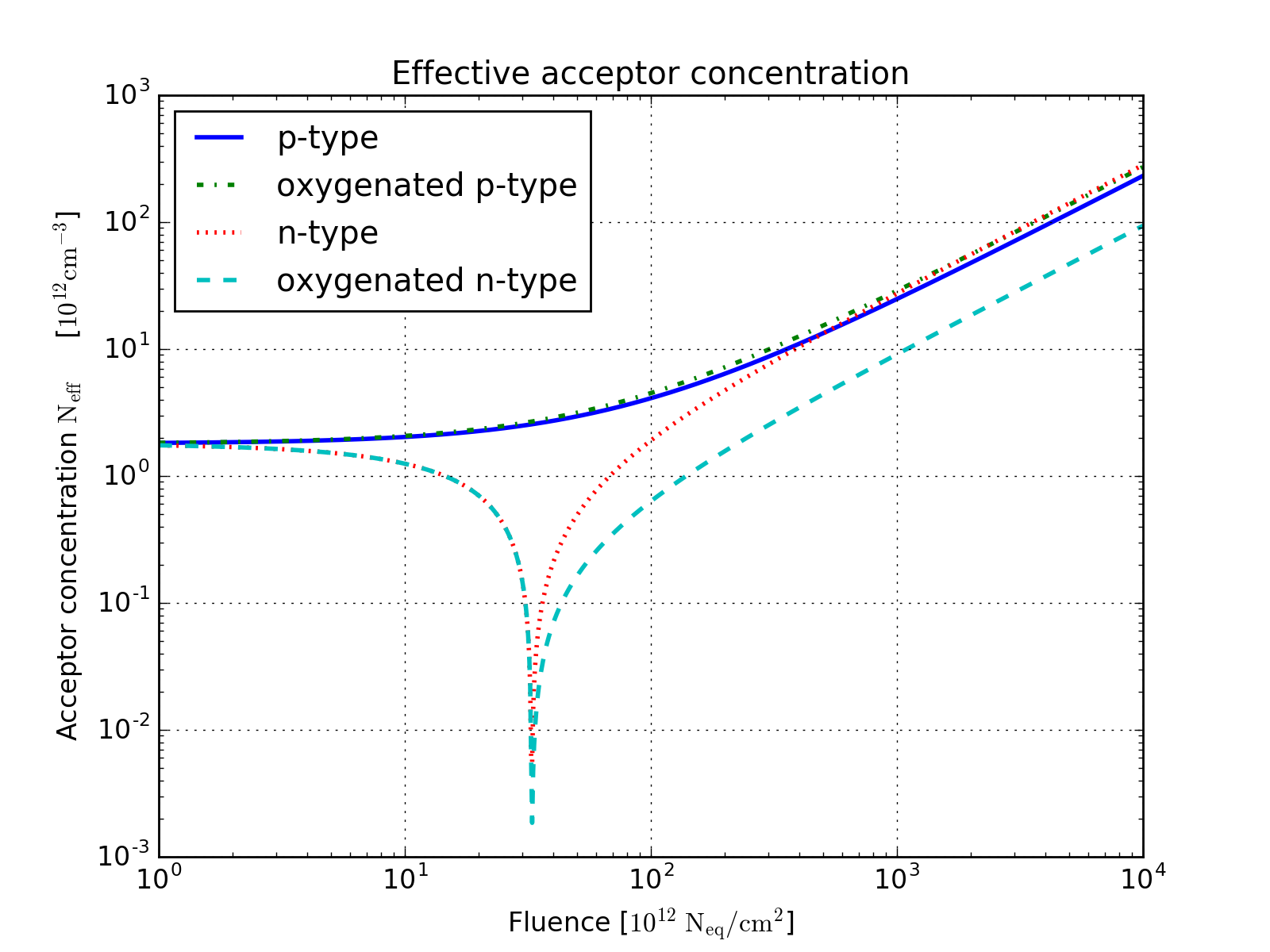
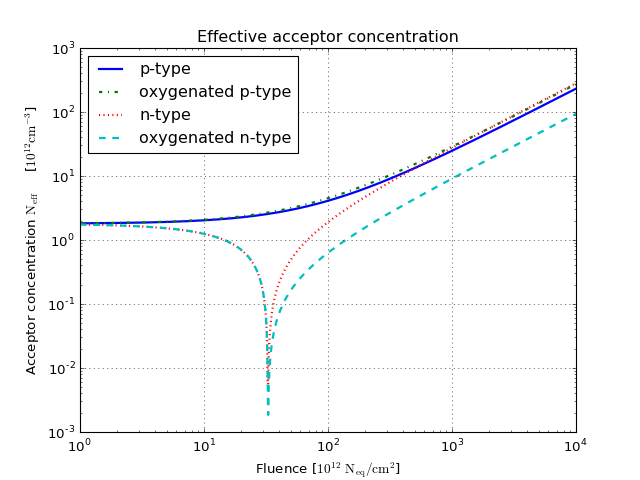
scarce.silicon.get_eff_acceptor_concentration()[source]¶ Effective acceptor concentration [10^12 cm^-3] of irradiated n- and p- type silicon with and without oxygen enriched as a function of the fluence [10^12 cm^-2]. The data can be desribed by different line fits. The parameters were extracted from a plot taken for n-type silicon from: CERN/LHCC 2000-009 LEB Status Report/RD48 31 Dec. 1999 and for p-type silicon from: RD50 Status Report 2006 CERN-LHCC-2007-005, p. 4-6
Due to the difference in the data for different technologies a rather large error on the propotionality factor of 10% is assumed.
(Source code, png, hires.png, pdf)
-
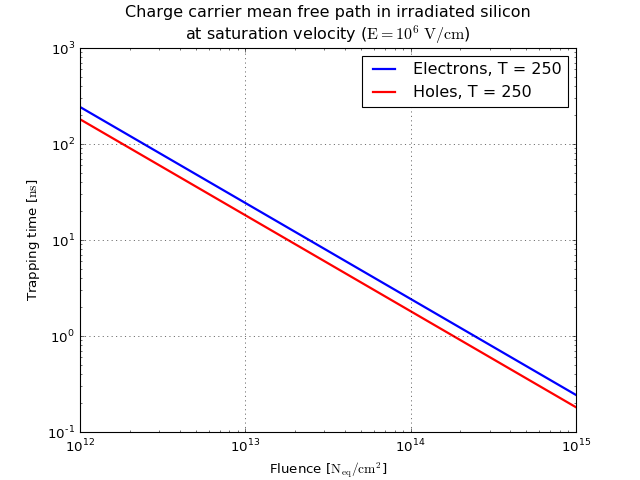
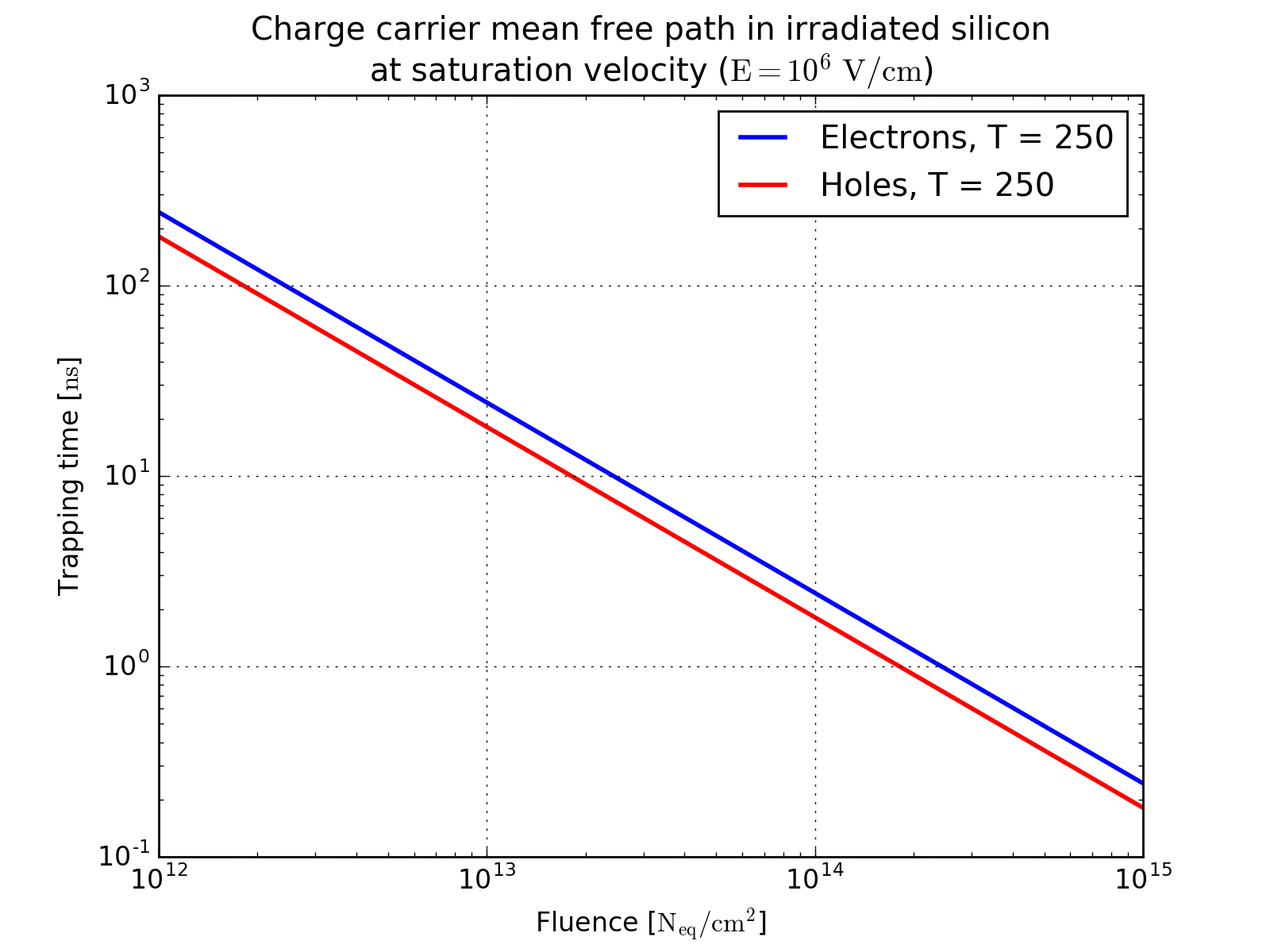
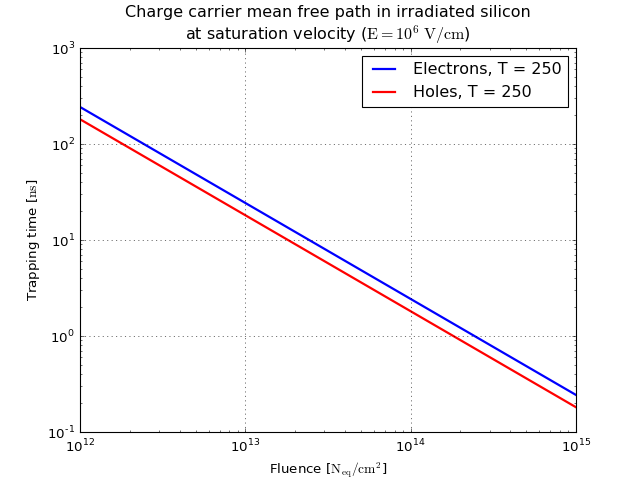
scarce.silicon.get_free_path()[source]¶ Calculate mean free path [cm] of charge carriers from trapping propability and the velocity. The trapping propability is a function of the fluence and the velocity is a function of the electric field and the temperature. The electric field itself depends on the electrode geometry and the bias voltage. velocity = get_mobility(e_field, temperature, is_electron) * e_field trapping_time = get_trapping(fluence, is_electron, paper=1)
(Source code, png, hires.png, pdf)
-
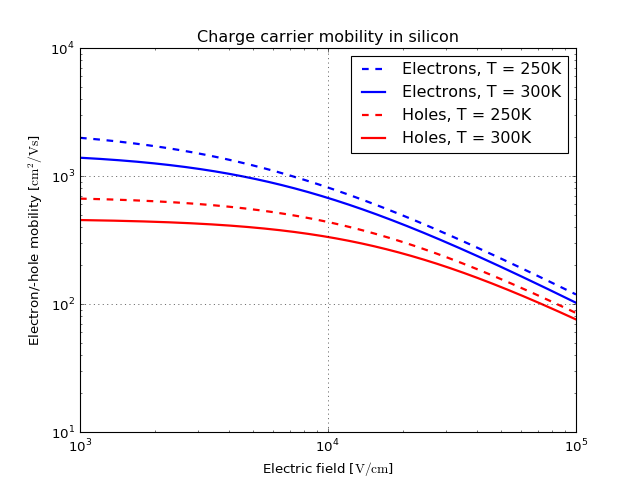
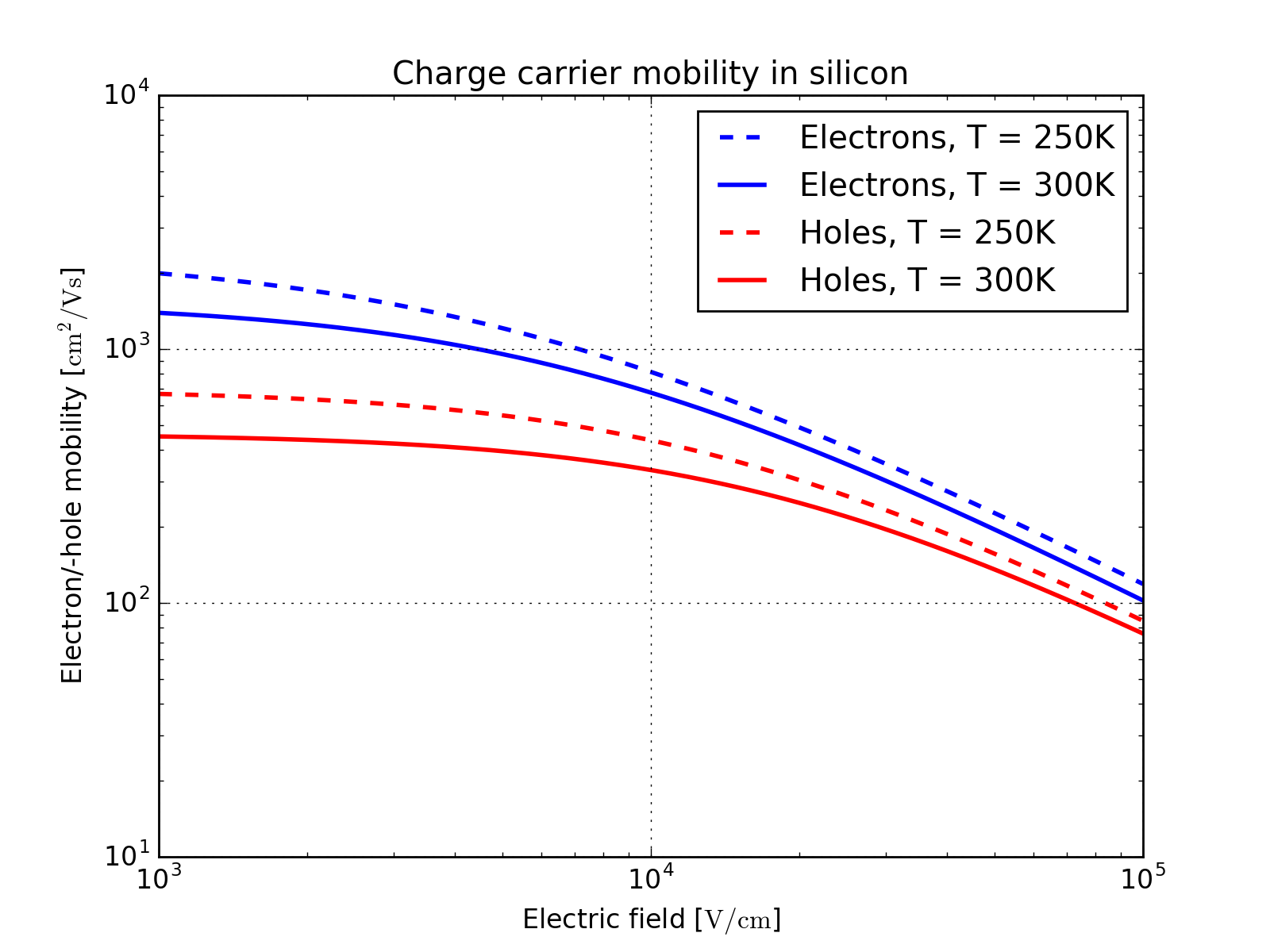
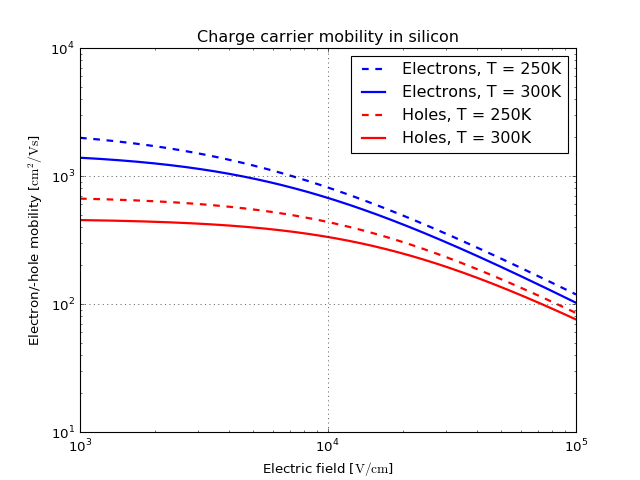
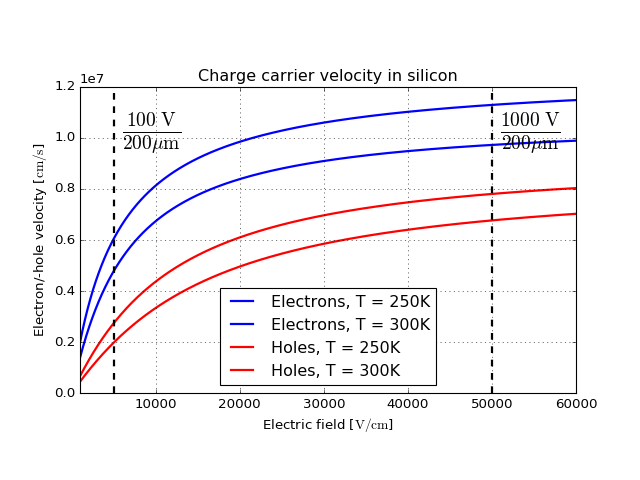
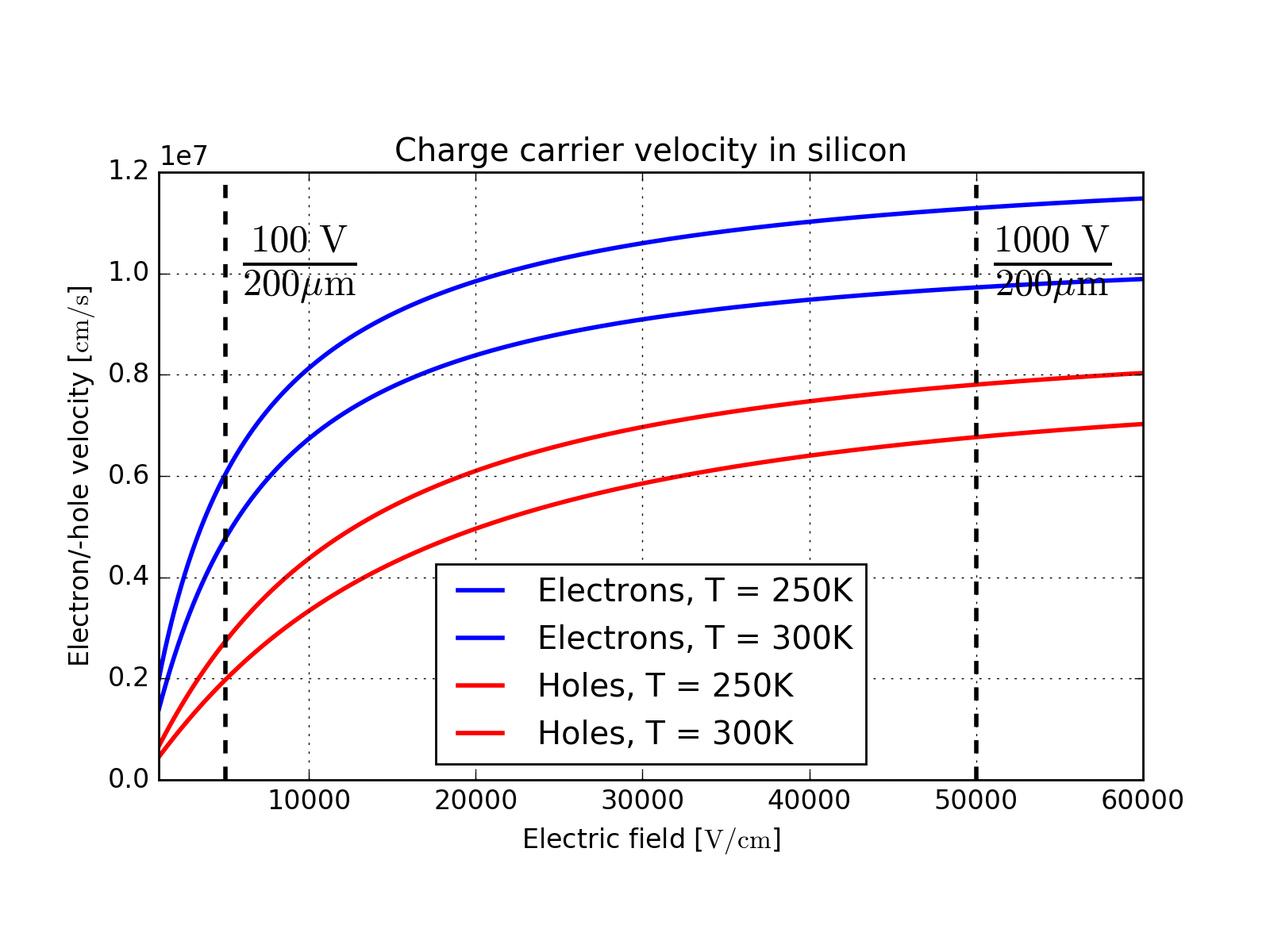
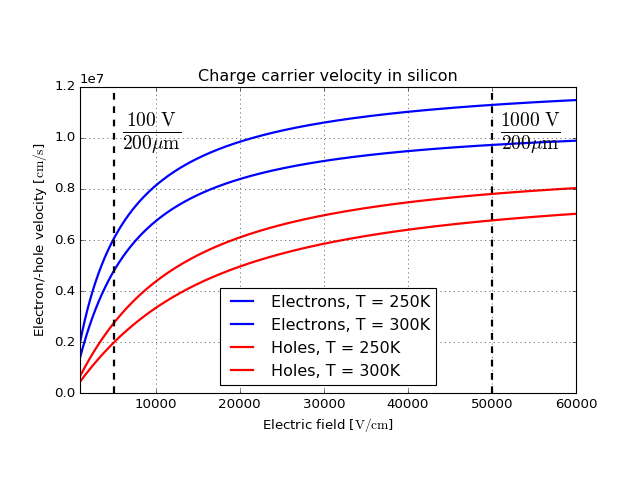
scarce.silicon.get_mobility()[source]¶ Calculate the mobility [cm^2/Vs] of charge carriers in silicon from the electrical field (E [V/cm]) the temperature (T [K]) and the charge carrier type (isElectron [0/1] otherwise hole).
Formular derived from measured data of high purity silicon and the corresponding fit function parameters are used here. From: C. Jacononi et al., Solid state electronics, 1977, vol 20., p. 87 ‘A review of some charge transport properties of silicon’
Note
The doping concentration is irrelevant for n_eff < 10^16/cm^3
(Source code, png, hires.png, pdf)
(Source code, png, hires.png, pdf)
-
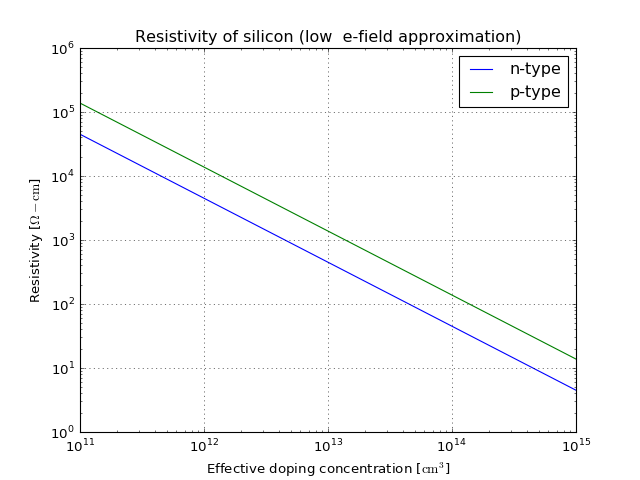
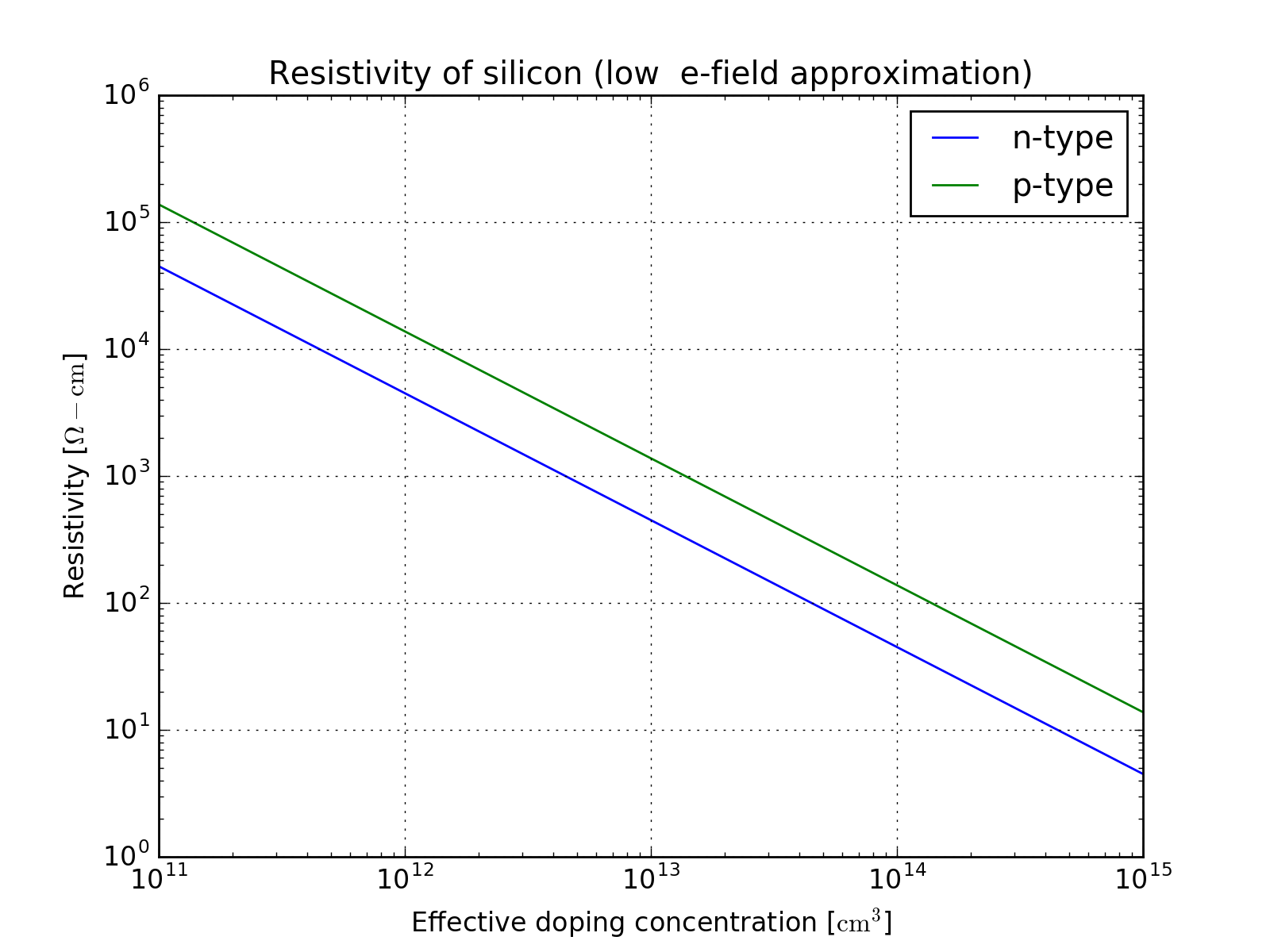
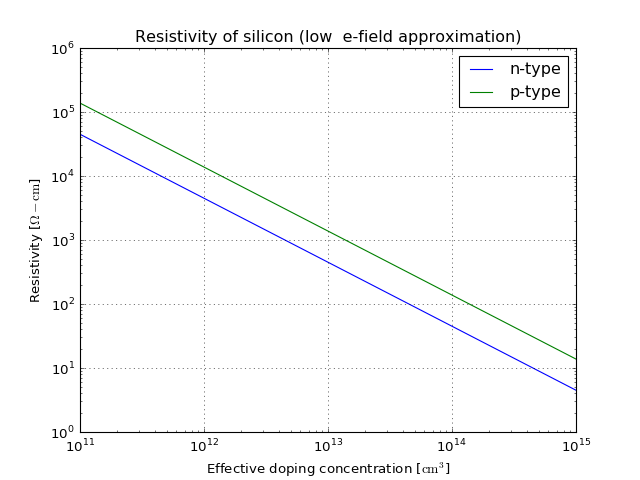
scarce.silicon.get_resistivity()[source]¶ Calculate the resitivity from: The effective doping concentration n_eff [10^12 / cm^3] the mobility [cm^2/Vs] for n- and p-type silicon.
The mobility istself is a function of the temperature [K] and the electric field [V/cm]. From http://ecee.colorado.edu/~bart/book/mobility.htm
TODO: If you take the mobility[E_field] equation seriously, then there is no constant resitivity since the mobility depends also on the electric field. For low E-Fields <= 1000 V/cm the mobility is independent of the E flied and thus the resistivity. Likely this parameter is always given in low field approximation?! Source needed!
(Source code, png, hires.png, pdf)
-
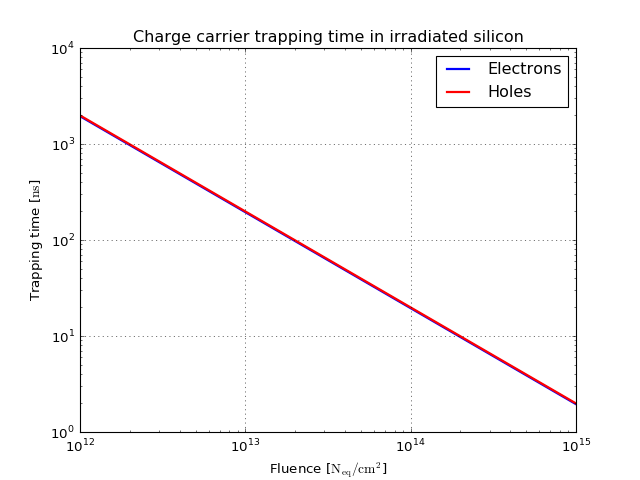
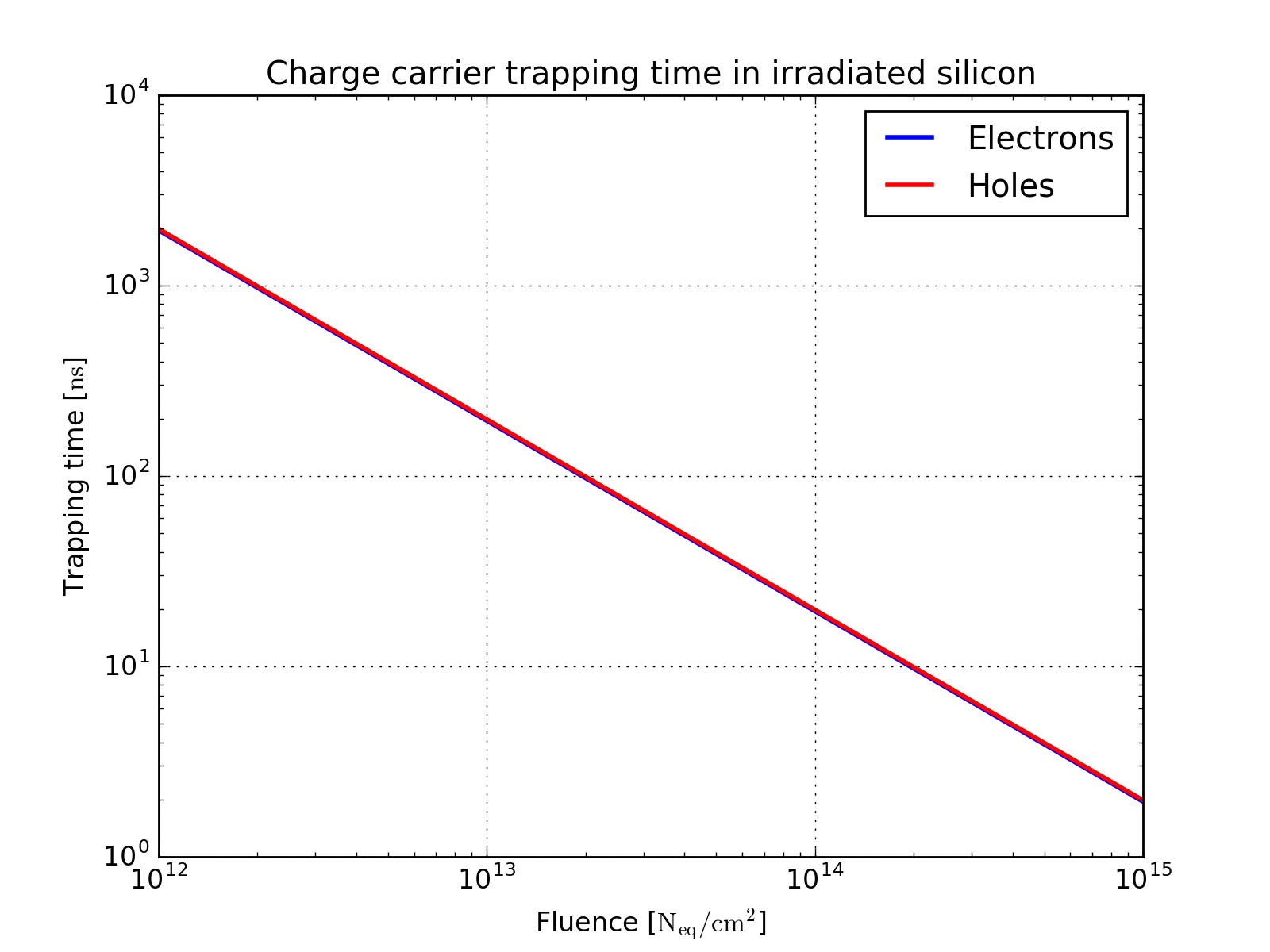
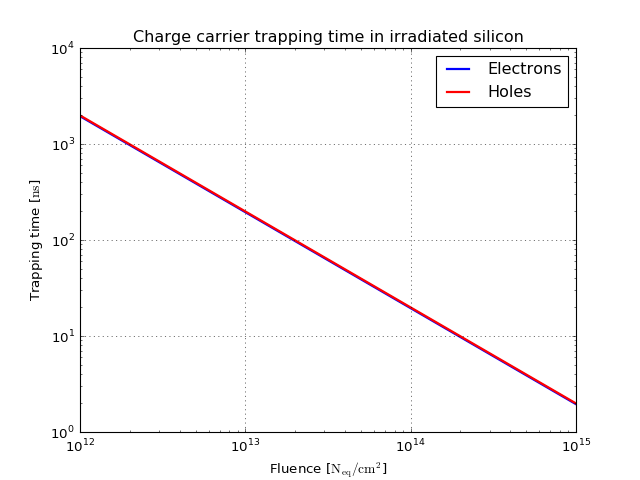
scarce.silicon.get_trapping()[source]¶ Calculate the trapping time tr (e^-(tr) in ns) of charge carriers in silicon as a function of the fluence [Neq/cm^2]. There was also a dependence on the temperature measured, that is omitted here!
(Source code, png, hires.png, pdf)